Our oceans need a safety net.
The Environment Protection and Biodiversity Conservation Act (EPBC Act) — our national environment law — or nature laws, are meant to protect the places we love.
We know Australia’s oceans and wildlife are in crisis. Iconic and irreplaceable species such as the Maugean skate, red handfish and giant kelp, are hanging on by a thread.
The strongest lifeline we can throw them is a set of modern and effective nature laws.
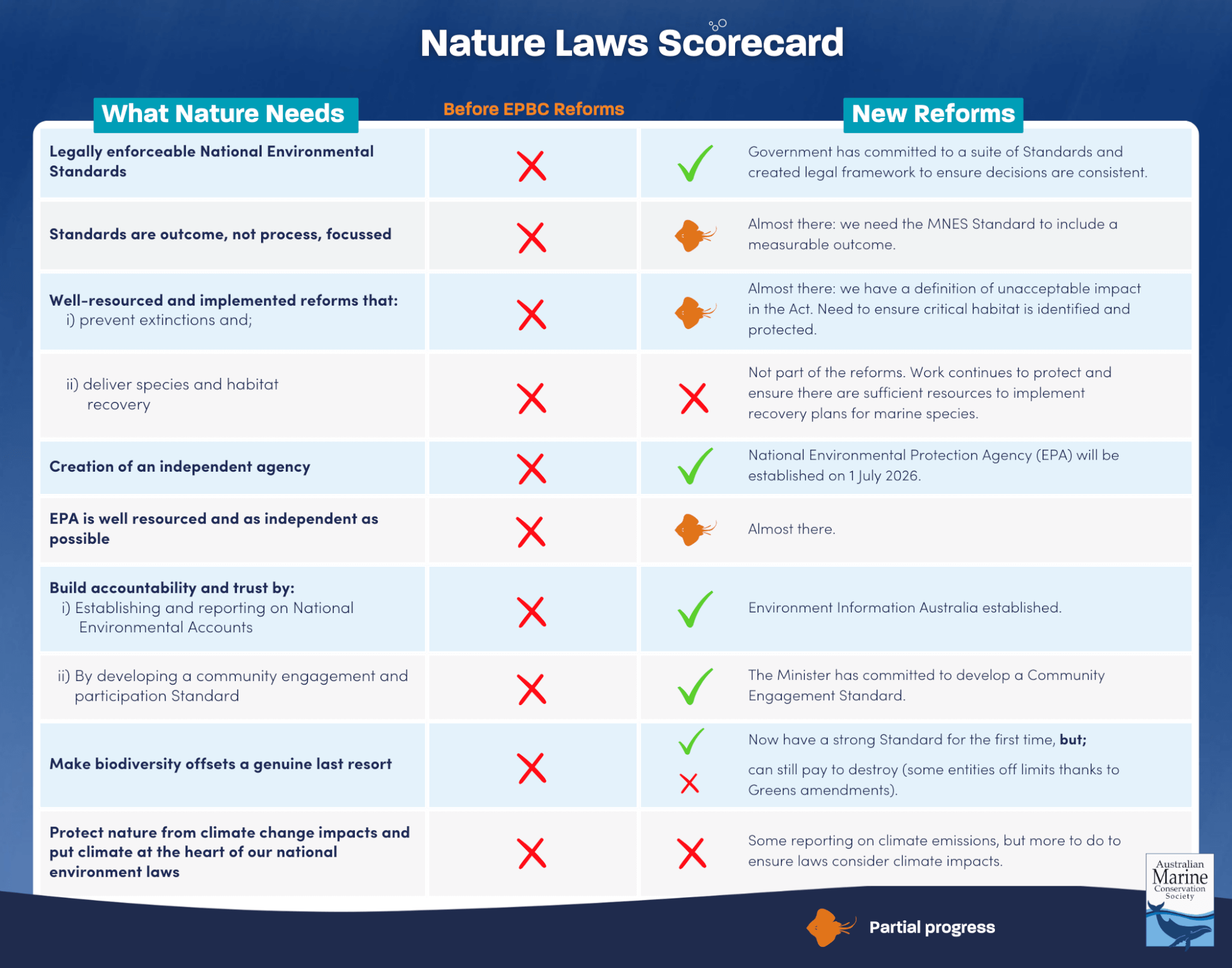
To help track their progress, we’ve created a simple scorecard. It’s a tool to hold the government accountable — and to ensure ocean protection isn’t left behind in the reform process.
Check out our updates below.
Update: December 2025
We did it! After years of working to get much needed reforms to Australia’s nature laws, in the final session of federal parliament for 2025 the package of reforms to the EPBC Act were passed. This is a landmark moment for Australia’s ocean, coasts and marine wildlife, and one we should celebrate.
However, it isn’t perfect and so the work continues.
To help track progress on this long running campaign to fight for stronger nature laws, AMCS created a scorecard as a tool to hold the government accountable — and to ensure ocean protection wasn’t left behind in the reform process. Below is a short summary of the key wins and our updated scorecard. We didn’t get everything we wanted. But we did get in place some strong foundations that take forward nature protection in Australia. The fight isn’t over, the failure to address climate change remains a glaring omission in our national nature laws. There is lots more to do to make sure these laws deliver what nature needs. But today, we are just so grateful for the thousand of AMCS supporters that never gave up, and to celebrate the change that we can make – together for our ocean, coasts and the wildlife we love.
Great news for the Reef
Thanks to over forty thousand AMCS supporters taking action, more than 100 scientists who signed an open letter calling on the Albanese Government to use upcoming nature legislation reforms to end tree clearing in the Great Barrier Reef, and the actions of many friends across the movement, we have seen historic reform of the Environment Protection and Biodiversity Conservation Act (EPBC Act) — our national environment law.
For over 25 years, clearing which has led to sedimentation impacting the World Heritage-listed Great Barrier Reef has been exempted from the protection of the EPBC Act.
The AMCS report launched in October documented that between 2018 and 2022 almost 700,000 hectares of vegetation was cleared in Reef catchments, contributing to sediment pollution.
Thanks to these reforms, from the 1st of December, trees along rivers and streams within the Great Barrier Reef catchment and vegetation over 15 years old can no longer be cleared without federal government approval. This is a huge step forward, and we will be monitoring the implementation of this closely in coming months.
The broader reform package
The original package of reforms to the EPBC Act proposed by the government included some positives, such as a definition of unacceptable impacts, a framework for National Environmental Standards to guide decision making, and a National Environment Protection Agency with a broader suite of compliance and enforcement tools. However, as outlined in the AMCS submission to the Senate Committee reviewing the Bills, this original package was compromised by other aspects of the reform package such as weaker offsetting rules, fast-tracked development pathways, relaxed devolution and national interest exemptions which significantly increases decision-maker discretion, and it failed to address exemptions that allowed deforestation in the Great Barrier Reef catchments.
Amendments passed through last-minute negotiations with the Greens in the Senate included a suite of positive reforms for nature. In addition to constraining the clearing exception described above, these included:
- exclusion of fossil fuels from streamlined assessment, national interest approval exemptions and bioregional planning pathways
- some safeguards around devolution of EPBC Act powers
- less discretion when applying National Environmental Standards
- an end date to the exemption of Regional Forest Agreements (RFAs) from the EPBC Act
- Constraints around offsets using the “pay to destroy” restoration fund
- Halving the period for reviewing operation of the Act
As well as these wins, the final agreement did weaken important definitions such as unacceptable impacts in response to industry concerns, and AMCS plans to watch this carefully in the coming months.
View this post on Instagram
Check out the resources below to recap on the importance of nature laws and what we have fought to achieve:
View this post on Instagram
Red Handfish

The red handfish is one of the rarest and most endangered fish in the world, found in just two small areas near Hobart. With a tiny population of 100 or so left in the wild, it’s crucial we protect this Critically Endangered fish (from pressures such as habitat degradation, pollution, coastal developments and climate impacts).

Giant Kelp
The Giant Kelp Marine Forests of South East Australia are a vital component of our marine ecosystem, providing critical habitats for many species and supporting the health of our oceans. Giant Kelp forests are facing unprecedented threats, and urgent action is needed to protect these vital ecosystems.

Maugean Skate
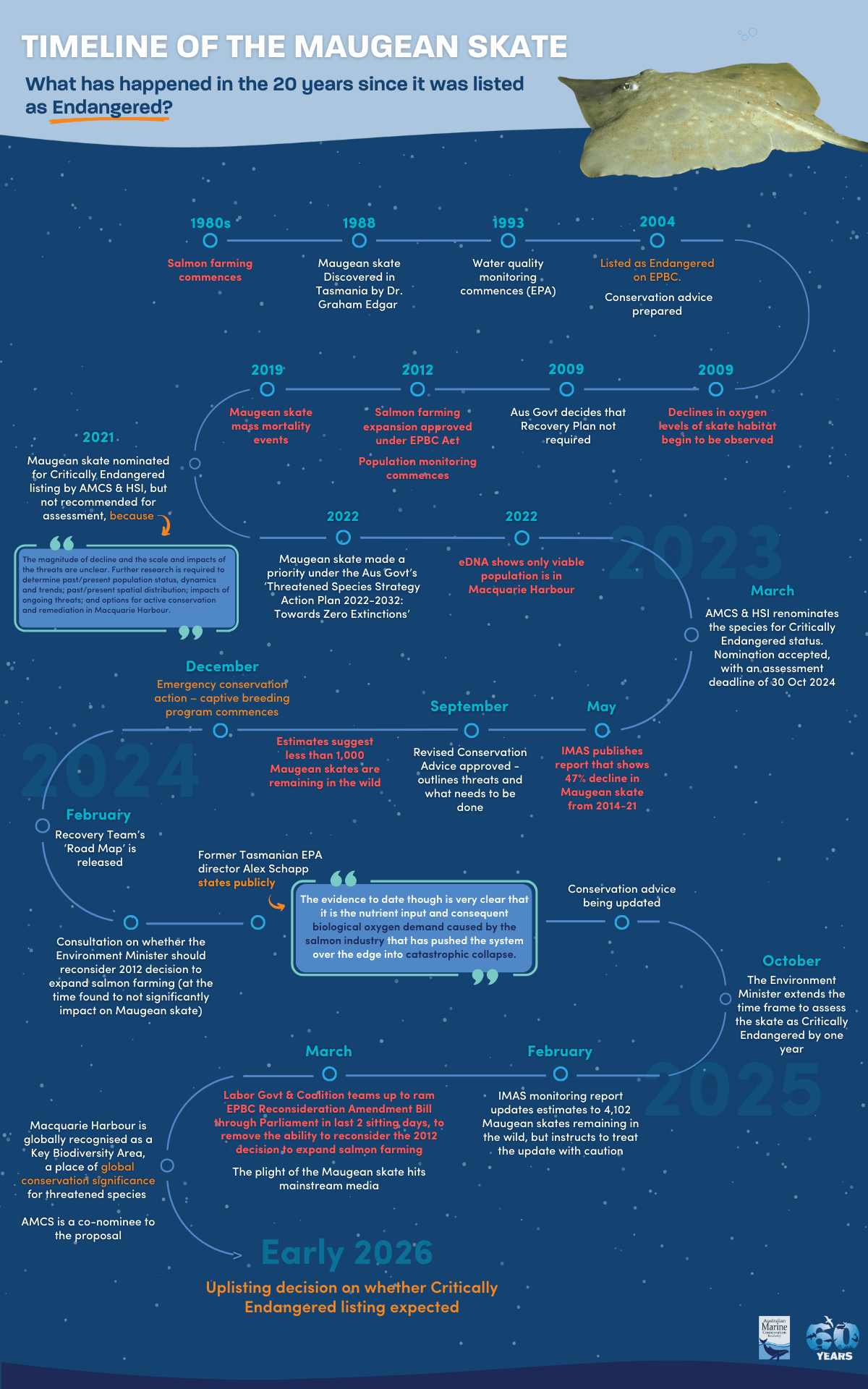
The Maugean skate is staring down the barrel of extinction, largely due to the failures of the EPBC Act. They are found only in Australian waters, with less than 1,000 estimated to be remaining in the wild. Salmon farming has decimated their habitat, poor water quality is suffocating them, and time is running out.
Featured image credit: Jane Rucker/IMAS