Throughout my life, I have witnessed the devastating harm plastic can inflict upon marine wildlife. It put me on a pathway that led me to my PhD in material science. Join me as we explore the dangers of plastic to humans and wildlife, and the solutions I believe offer a realistic pathway out of this crisis and toward ending plastic pollution.
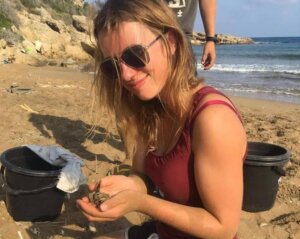
Dr Eleanor Mullen working with sea turtles in Cyprus.
When I was about seven years old and living in Ireland, I had a book I was obsessed with. It was about the extinction of animals, and which species were classified as endangered. I could not understand how these beautiful creatures were under so much threat. What had made their environment so hard to survive in?
Seven-year-old me decided that protecting these creatures and their homes would be my focus for life. That same year I wrote to the Irish government and asked them to “ask the other governments to stop cutting the trees down”. I got a letter back assuring me they would do their best. It was even signed by the Taoiseach (the Prime Minister of Ireland). For a while I thought that it had solved all our problems.
Eventually, I realised there were many different reasons for species extinction and many of the solutions were unknown. I wrote to Sir David Attenborough when I was about fifteen to ask his advice. He replied and advised me to choose a subject in university that I would excel at and through that career work to prevent further extinctions. But with so many interconnected threats facing our wildlife, I didn’t know where to start.
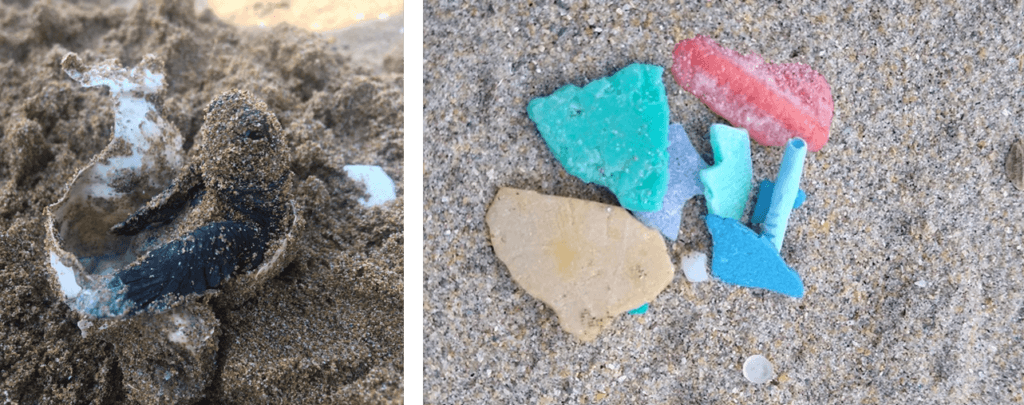
Turtles hatching amongst plastic pollution on a beach in Cyprus in 2016. Photos by Dr Eleanor Mullen.
Hatching Ideas
Then, one summer, I worked with sea turtles in Cyprus. This became a defining experience that set me on my career path. One of the nesting sites I was monitoring was late hatching, so we decided to excavate the top of the nest to see why. What I saw next broke my heart – we were met with layers of plastic which covered the nest. Underneath, we found the trapped turtle hatchlings. Most had died, but some, deep within the nest, had managed to survive. I didn’t sleep at all that night. I couldn’t understand how we could mass produce a material with such deadly consequences with no way to ensure it doesn’t cause harm.
I decided to begin a research career focusing on how materials impact our environment and how they threaten those species in that book from my childhood. In October 2019, I embarked on a PhD focusing on environmentally responsible development of new technologies.
Sustainability is often an afterthought
I find it fascinating how often sustainability and environmental impact is an afterthought. It’s too often only considered once a new material, or machine has been developed and sold on the global market.
During my PhD, I decided to challenge this idea. My PhD focused on a new way to make the patterns on electronic chips used in devices such as your computer and phone. One of the materials used to make these patterns are plastic polymers! Plastic polymers are also used to ‘glue’ different parts of the phone together, for the outer casing and even in the latest foldable phone screens.
Lately our phones and computers have become smaller. This has been made possible by the circuits on computer chips becoming smaller. It’s an incredible feat of engineering that we now walk around with thin light-weight phones in our pocket. However, the design of this technology focused on delivering the best product without regard for how to minimise negative environmental impacts.
It’s very expensive to re-engineer the entire manufacturing processes of billion-dollar industries. When I was designing a new way to make the patterns on these chips, I decided to put together a framework on how to develop new technologies with sustainability in mind.
Sustainability by design
I launched my ideas in a scientific paper in 2021. In the paper, I outlined how we can systematically record all the materials, energy and resources used by a new electronic chip manufacturing process using a method called life cycle analysis. By understanding how material or energy is used, the process can then be re-optimised and re-designed to reduce waste. This leads to a design that is optimised not just for functionality or performance but also for sustainability.¹
The publication led to invited talks and engagement with a range of organisations and companies, including the Next G Alliance in the USA (members included Apple, Google, and Intel) and LAM Research. We discussed the future of sustainability-by-design manufacturing in the electronics industry.
These companies were interested in the idea that sustainable by design technology development could reduce the environmental impact of the electronics industry globally.
Life cycle analysis can also be used to evaluate the impacts of a huge range of products and packaging. Reducing waste and resource use is not only good for sustainability, it’s good for business. It can save time and money, and ensure that production methods meet new environmental regulations.
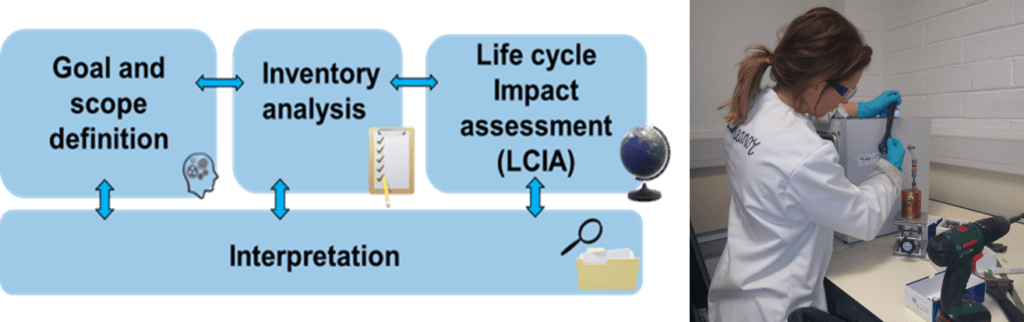 Life cycle analysis stage (left) and Dr Eleanor Mullen working on the construction of a new approach for electronic chip manufacture (right); Life cycle impact assessment looks at environmental impact and the final interpretation stage can be used to summarise findings. Goal definition and scope is where you decide the assessment objectives. Inventory analysis can be considered making a sort of shopping list of all materials, energy and resources needed for the process.
History’s lesson
Too often, materials are manufactured and sold without proper assessment of the risks they pose. This has happened throughout human history. It has had, and continues to have, huge human health and environmental consequences.
The threat that plastics pose to the health of humans is hard to measure and is currently under research. What we do know, however, is that plastic is a persistent pollutant with a well-documented impact on marine life through entanglement and ingestion.² Just as I had seen in Cyprus, plastic can alter sediment composition, coastal habitats, and the behaviours of the animals that depend upon them.³
Then there are the emissions. At least 98% of plastics are made from fossil fuels, usually oil.6 The production of plastic releases greenhouse gases and other pollutants that are contributing to climate change. Australia’s plastic use produced more than 16 million metric tonnes of greenhouse gas emissions in 2020 – this is equal to the emissions from around 5.7 million cars on the road every year.⁴ The pollution from plastic production often occurs in areas where communities are already vulnerable and disadvantaged, exposing them to toxic emissions in water, soil and air.⁵
Simple solutions to a complex threat
The pathway I personally see forward is to reduce our dependence on single-use plastics as much as possible. In the meantime, it is vital that we continue to investigate how plastics behave when they leak into our environment and what the human health and environmental consequences are. We can, and must, re-design how plastics can be used safely through informed decision making.
My hope is that the future of technology and material design will consider what the environmental impact is during the initial design phases. That way, we can avoid escalating mass scale production of a material like plastics without a long-term plan of what to do with them if they leak into the environment, or when they reach end of use.
The lasting image of those dead turtle hatchlings demonstrates how plastic is an overwhelming and complex threat. I hope this article will inspire you to push for research on the impacts of plastics, and to join me in considering how materials shape our lives and our planet.
Written by By Dr Eleanor Mullen, Sustainable Materials Research Scientist. This article was written in a personal capacity. The views expressed are solely those of the author and do not reflect the views of any university or affiliated institution
References
- Mullen, E.; Morris, M. A. Green Nanofabrication Opportunities in the Semiconductor Industry: A Life Cycle Perspective. Nanomaterials 2021, 11 (5). https://doi.org/10.3390/nano11051085.
- Australian Marine Conservation Society. Ocean Plastic Pollution. Australian Marine Conservation Society webpage. https://www.marineconservation.org.au/ocean-plastic-pollution/ (accessed 2026-01-26).
- Zhu, X.; Rochman, C. M.; Hardesty, B. D.; Wilcox, C. Plastics in the Deep Sea – A Global Estimate of the Ocean Floor Reservoir. Deep. Sea. Res. 1 Oceanogr. Res. Pap. 2024, 206 (November 2023), 104266. https://doi.org/10.1016/j.dsr.2024.104266.
- Australian Marine Conservation Society. Climate impacts of plastic consumption in Australia https://www.marineconservation.org.au/plasticemissions.
- Yates, J.; Deeney, M.; Muncke, J.; Carney Almroth, B.; Dignac, M. F.; Castillo, A. C.; Courtene-Jones, W.; Kadiyala, S.; Kumar, E.; Stoett, P.; Wang, M.; Farrelly, T. Plastics Matter in the Food System. Commun. Earth Environ. 2025, 6 (1). https://doi.org/10.1038/s43247-025-02105-7.