Australia is a living library of millions of years of evolutionary shark and ray history, making our waters some of the most unique in the world. Nearly half (42%) of Australia’s 331 species of shark and ray are endemic [1] – that is, they aren’t found anywhere else in the world! Alarmingly, industrialised fishing in south-eastern Australian waters is pushing many of our unique species to extinction, such that endemic species in this region make up over a quarter (12/39) of all Australia’s threatened shark and ray species [1].
Without addressing our fisheries, we risk transitioning from an endemic hotspot to an extinction hotspot.
Take action today and tell the government to protect our endangered sharks and rays
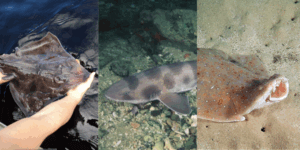
Meet our Aussie battlers up for protection under Australia’s nature laws:
By March 2027, it is expected that five of Australia’s threatened endemic species will be listed under Australia’s nature laws, the Environment Protection and Biodiversity Conservation Act 1999 (EPBC Act). At the time of writing, the Maugean skate is the only threatened endemic species listed on the EPBC Act.
Let’s meet our unique species!
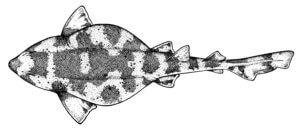
Whitefin swellshark (Cephaloscyllium albipinnum) – Critically Endangered*
When threatened, whitefin swellsharks swallow water to make themselves look bigger and harder to eat. Unlike most sharks that give live birth, swellsharks lay eggs called ‘mermaid purses’. Despite the danger they’re in, it is legal to catch them and sell their meat, commonly called ‘flake’, at fish shops. Up to 90% of their population has been lost in the past 57 years due to trawl nets sweeping the seafloor and deep-water longlines, which have hundreds of hooks [2].
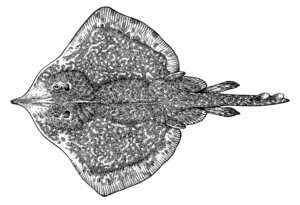
Australian longnose skate (Dentiraja confusa) – Critically Endangered*
Longnose skates live up to 600m deep, preferring soft sandy or muddy areas to lay their eggs and find crabs, worms and squid for food. Over 80% of their population has been lost in the past 27 years due to trawl nets sweeping the seafloor and deep-water longlines, which have hundreds of hooks [3].
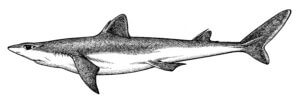
Greeneye spurdog (Squalus chloroculus) – Endangered*
Living in water over 1000m deep, greeneye spurdogs’ large green eyes help them see in the dark. They have one of the longest pregnancies in the world, at nearly three years! [4]
A 2024 DNA study revealed that their meat was sold as ‘flake’ at a Victorian fish shop [5]. At least half of their population has been lost in the past 63 years due to trawl nets sweeping the seafloor and deep-water longlines, which have hundreds of hooks [4].
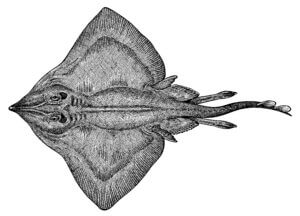
Grey skate (Dipturus canutus) – Endangered*
Grey skates live up to 1050m deep on the continental slope, preferring soft sandy or muddy areas to lay their eggs. They likely specialise in eating crustaceans, primarily antlered crab (Dagnaudus petterdi) and squat lobsters (Galatheids), as very few bony fish have ever been found in their stomachs. It is estimated that 58% of their population has been lost in the past 38 years, primarily because of trawl nets sweeping the seafloor [6].
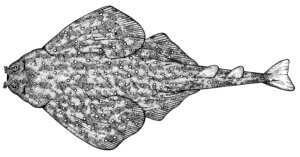
Eastern angelshark (Squatina albipunctata) – Vulnerable*
The Eastern Angelshark buries itself in the sand, perfectly camouflaged and ready to ambush any unsuspecting prey that swims above it. Hunting mostly at night, it eats bony fish and cephalopods like octopus. Caught primarily by fishing trawlers that scoop them up in nets, they are often sold in fish shops as ‘boneless fillet’ or ‘flake’. It is estimated that more than 30% of their population has been lost in the last 69 years [7].
*Threatened Category being assessed for under EPBC Act.
What makes endemic sharks and rays unique to Australian waters?
Approximately 180 million years ago, all the continents were united in a single supercontinent known as Gondwana. Over time, Gondwana started to break apart, and Australia drifted away from the other continents around 45 million years ago.
As Australia moved over millions of years, sea levels changed, and deep ocean trenches and basins formed. This movement created extensive underwater barriers that separated Australia from surrounding islands, such as Indonesia and New Zealand. As a result, many sharks and rays evolved in isolation in Australian waters, much like how many of Australia’s land animals are unique because of geographic isolation.
Today, nearly half (42%) of Australia’s 331 species of sharks and rays are endemic – found nowhere else in the world!
Why are sharks and rays threatened with extinction?
Some sharks and rays end up in our seafood, commonly known as “flake”. This makes it nearly impossible to know if endangered species, like the greeneye spurdog, are ending up on our plates. We need to be aware of the impact of our food choices and take action to protect these amazing creatures.
The waters from southern Queensland through to southeastern Victoria and Tasmania are the most dangerous place for sharks and rays because that is where most of Australia’s industrialised fishing happens. For many of our endemic species, trawling on or near the seafloor is a significant threat, causing them to be swept up in giant scoop nets. Longlines sunk to the seafloor are also a threat, with hundreds or thousands of baited hooks that can be stretched out for over a kilometre. In many cases, sharks and rays are caught incidentally; however, some that are killed can be kept (‘byproduct’). Although some species are released alive (‘bycatch’), their chances of survival following such a stressful event are uncertain. Other threats, like habitat loss and degradation, also threaten our threatened endemic species.
Just like humans, sharks and rays take a long time to grow up and have offspring (‘pups’). Most threatened endemics are deep-water species, where reproduction can be especially slow compared to their shallow-water counterparts. Many of our endemic species are at risk of disappearing forever because we’re catching them faster than they can reproduce.
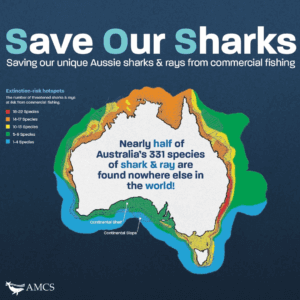
Heupel, M.R., et al (2018). Shark Action Plan Policy Report. Report to the National Environmental Science Program, Marine Biodiversity Hub. Australian Institute of Marine Science.
How can we save our endemic sharks and rays?
There is hope! Australia has the resources and expertise to save these species—if we act now. Here’s what must be implemented and continually improved upon to save our Aussie battlers from extinction:
- ‘No-take’ rules – species are protected from targeted fishing, which can include listing as a threatened species in Australia’s and/or a state’s nature laws. If caught, they have to be returned to the water.
- Cameras and scientists on boats – critical data that reveals which species are caught, where, and how many. Catch and biological data (e.g., sex, age) are crucial for identifying interaction ‘hotspots’ and areas that could be critical habitats (e.g., breeding grounds) and require protection.
- Trigger limits – the fishing stops when too many of a species are accidentally caught. Setting a catch limit that is determined by scientists so that the population can recover in numbers in the shortest time possible for that species.
- Marine sanctuaries – designated areas, critical to the survival of endangered endemic species, where no extractive activities, including fishing, are allowed.
These uniquely Aussie sharks and rays are ours and ours alone.
If we can’t save them, no one can.
Australia’s threatened endemic species:
- Australian longnose skate: Critically Endangered (IUCN/Australian Red List)
- Whitefin swellshark: Critically Endangered (IUCN/Australian Red List)
- Greeneye spurdog: Endangered (IUCN/Australian Red List)
- Maugean skate: Endangered (EPBC Act; IUCN/Australian Red List)
- Coastal Stingaree: Endangered (IUCN/Australian Red List)
- Eastern angelshark: Vulnerable (IUCN/Australian Red List)
- Colclough’s shark: Vulnerable (IUCN/Australian Red List)
- Sydney skate: Vulnerable (IUCN/Australian Red List)
- Melbourne skate: Vulnerable (IUCN/Australian Red List)
- Estuary stingray: Vulnerable (IUCN/Australian Red List)
- Yellowback stingaree: Vulnerable (IUCN/Australian Red List)
- Greenback stingaree: Vulnerable (IUCN/Australian Red List)
Locations:
- Australian longnose skate – NSW, TAS, VIC
- Whitefin swellshark- NSW, TAS, VIC, SA, WA
- Greeneye spurdog – NSW, TAS, VIC, SA
- Maugean skate – TAS
- Coastal stingaree – SA
- Eastern angelshark – QLD, NSW, VIC
- Colclough’s shark – QLD, NSW
- Sydney skate – QLD, NSW
- Melbourne skate – NSW, TAS, VIC, SA, WA
- Estuary stingray – NT, QLD, NSW
- Yellowback stingaree – QLD, NSW
- Greenback stingaree – QLD, NSW, TAS, VIC, SA
References:
- Kyne, PM. et al (2021) The Action Plan for Australian Sharks and Rays 2021. NESP Marine Biodiversity Hub, Australia.
- Threatened Species Scientific Committee (2025) ‘Consultation on Species Listing Eligibility and Conservation Actions – Whitefin swellshark (Cephaloscyllium albipinnum).’ Department of Climate Change, Energy, the Environment and Water, Australian Government. Canberra, Australia.
- Threatened Species Scientific Committee (2024) ‘Consultation on Species Listing Eligibility and Conservation Actions – Australian longnose skate (Dentiraja confusa).’ Department of Climate Change, Energy, the Environment and Water, Australian Government. Canberra, Australia.
- Threatened Species Scientific Committee (2025) ‘Consultation on Species Listing Eligibility and Conservation Actions – Greeneye spurdog (Squalus chloroculus).’ Department of Climate Change, Energy, the Environment and Water, Australian Government. Canberra, Australia.
- Kielniacz, TJP et al (2024) ‘High Levels of Mislabelling of Shark Flesh in Australian Fish Markets and Seafood Shops.’ Marine and Freshwater Research 75, no. 7.
- Threatened Species Scientific Committee (2024) ‘Consultation on Species Listing Eligibility and Conservation Actions – Grey skate (Dipturus canutus).’ Department of Climate Change, Energy, the Environment and Water, Australian Government. Canberra, Australia.
- Threatened Species Scientific Committee (2025) ‘Consultation on Species Listing Eligibility and Conservation Actions – Eastern angelshark (Squatina albipunctata).’ Department of Climate Change, Energy, the Environment and Water, Australian Government. Canberra, Australia.
- Heupel, M., Kyne, P., White, W. & Simpfendorfer, C. (2018) ‘Shark Action Plan Policy Report.’ Report to the National Environmental Science Program, Marine Biodiversity Hub. Australian Institute of Marine Science.