While customers in Australian supermarkets are met with endless aisles of disposable plastic packaging, a few supermarkets overseas are demonstrating that not only is reuse in supermarkets possible, it’s thriving and their customers love it.
Before we dive into these international examples, let’s talk about the different types of reuse and refill.
While there are lots of types of reuse and refill, the Ellen Macarthur Foundation categorised four main types of reusable and refillable packaging options for business-to-customer (B2C) packaging.¹ The main difference between these is who owns the packaging.
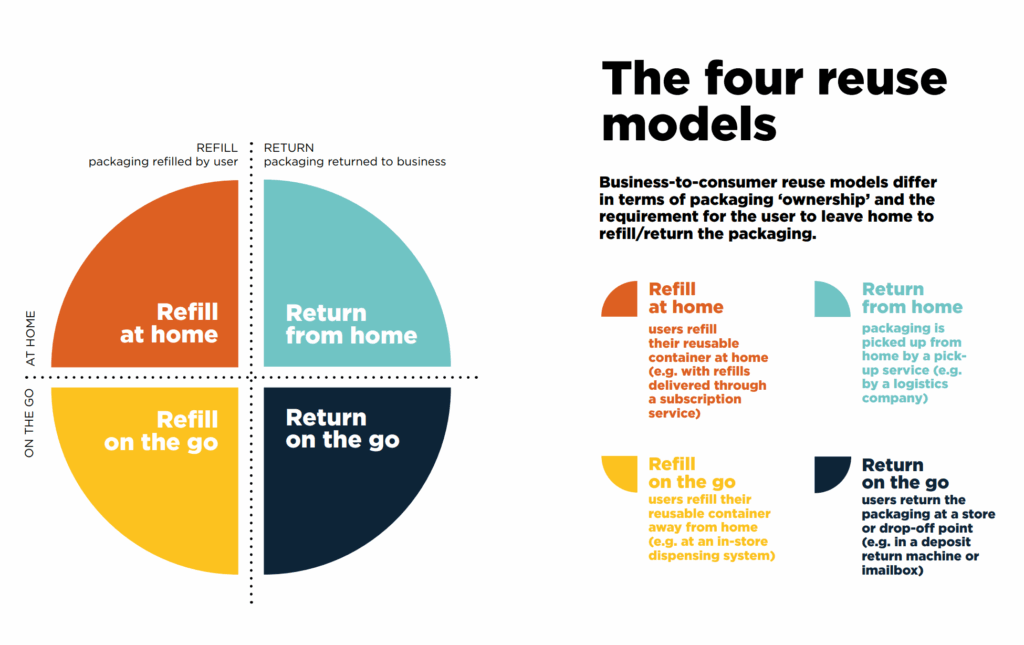
- Refill at home.
Customers own the packaging, and refill it themselves as home.
E.g. Dissolvable tablet for cleaning product – you buy the tablet, put it in your container, add water, and use. When it’s empty, you buy a new tablet and start over again. - Refill on-the-go.
Customers own the packaging, and refill it themselves in the store.
E.g. You take your container to the supermarket, fill it with a product (let’s say cleaning product again), and take it home. When it’s empty, you wash it and bring it back to the store to be filled again. - Return from home.
A business owns the packaging, collects it from your home, cleans it, and fills it over and over again.
E.g. Your favourite cleaning product comes in a reusable bottle which you buy from a store, or online. It’s delivered full, you use it, arrange for it to be collected, where the company who owns it washes it, refills it, and sells it to the next person. - Return on the go.
A business owns the packaging, collects it from a drop-off location, cleans it, and fills it over and over again.
E.g. Your favourite cleaning product comes in a reusable bottle, which you buy from a store or online. It’s delivered full, you use it, and drop it off at the supermarket or some other drop-off point. The company collects it, cleans it, refills it, and sells it to the next person.
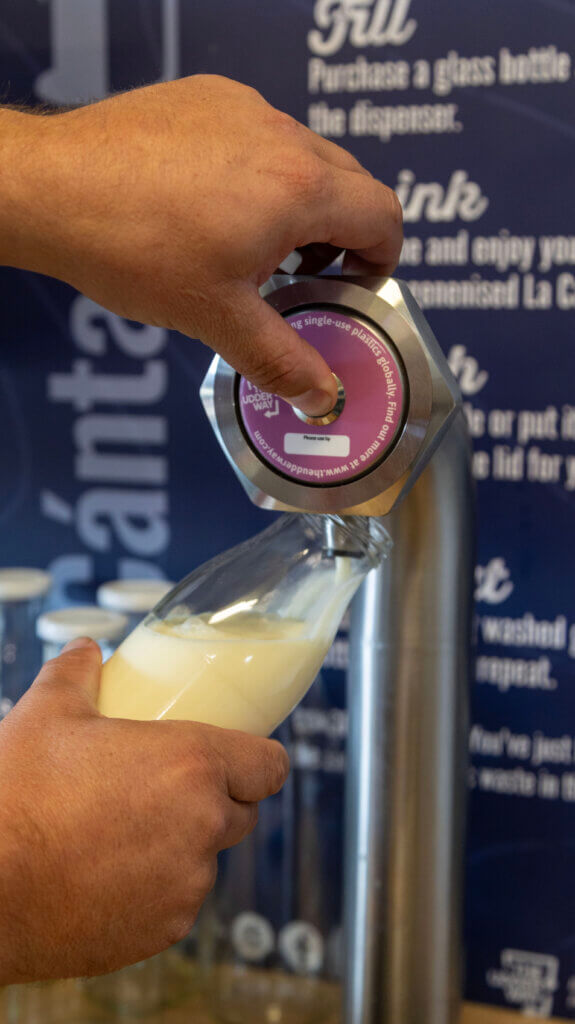
The Udder Way – refillable milk station
Ocado and ALDI – UK

Refill Coalition – GoUnpackaged at ALDI UK
Two supermarkets in the UK trialled reusable packaging in two different ways – one for online customers (return from home), and one in-store (refill on-the-go).
Ocado supermarkets introduced a select range of its own-brand products in reusable plastic containers. Online customers could choose items like pasta, rice and laundry detergent in containers designed for reuse, which were dropped off for delivery. Once the customers had used all the contents, or decanted the contents into their own container, they left the empty containers with the next delivery driver, who took them back to the store to be collected, washed, and refilled for the next customer. Ocado chose not to charge a deposit for the containers for the trial, but had very high return rates regardless. This may be due to the fact that these containers were designed to be “functionally ugly” so that customers were not tempted to keep them at home.
ALDI UK customers shopping in select stores were able to purchase a range of breakfast cereals in their own containers, or in containers available for purchase. Customers weigh their container, fill it with their chosen cereal, then weigh the container again. This option allows customers to buy exactly the amount needed, though it does rely on customers remembering to bring their containers to the store when doing their shopping.
In both the Ocado and ALDI trials, staff said the systems were easy to use, and customers loved them. Their only complaint? They wanted more products available in reusable containers.
Carrefour – France
Carrefour supermarkets in France have taken another route for reuse in supermarkets. Introducing the Loop reuse system in 345 stores, Carrefour stocks more than 370 products from participating brands on the shelf in reusable packaging. The customer places it in their cart as usual, pays a small deposit (no more than 1 Euro, or around $1.70AUD per packaging item), and checks out as normal. When the container is empty they can either place containers in a Loop return bag and drop off at supermarkets, or drop containers into a reverse vending machine. In both cases, customers are reimbursed for their deposits, containers are washed, refilled, and placed on the shelf again and again.
What about Australia?
Reusable packaging requires well-designed systems in place for collecting, washing, and redistributing – but when made convenient and price-competitive, it’s an incredibly effective way to reduce disposable plastic packaging. It even performs better than disposable packaging against most, if not all, environmental indicators, including greenhouse gas emissions and water use.
At the time of writing, none of the four biggest supermarkets in Australia have a plan or policy to increase the amount of products they sell in reusable or refillable packaging. There are ample opportunities for supermarkets to introduce reusable and refillable packaging to their customers. We recommend Coles and Woolworths, who both currently offer online shopping and home delivery, introduce reusable and refillable packaging for online customers, but neither have plans to offer this option.
References
- Ellen Macarthur Foundation (2020). Upstream innovation: A guide to packaging solutions
Banner image: Refill Coalition – GoUnpackaged ALDI UK install day