Most Australians aren’t aware that the Great Barrier Reef is home to Australia’s largest coral fishery. But what is a coral fishery? How is that legal? And is it sustainable? Read on to find out more about the Queensland Coral Fishery, and what you can do to help put an end to coral harvesting from our greatest natural wonder.

What is the Queensland Coral Fishery?
The Queensland Coral Fishery is a licenced commercial fishery permitted to take corals for sale from the Great Barrier Reef.
The Queensland Government allows 59 licence holders to operate, however, some businesses own multiple licences. Businesses also require permits issued by the Great Barrier Reef Marine Park Authority. Fishers are permitted to take corals from Conservation Park, Habitat Protection, and General Use Zones of the Reef which together make up almost two thirds of the Great Barrier Reef Marine Park (64%).
Fishers use commercial dive gear and hand held tools such as hammers and chisels to break off corals or parts of corals.
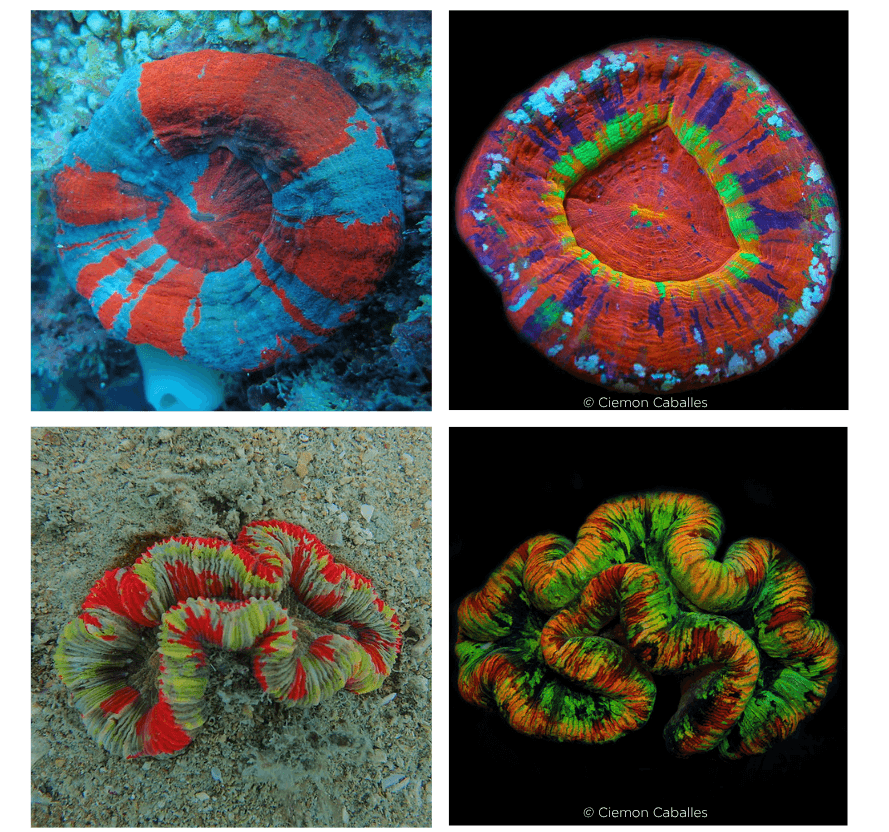
Coral species targeted by the Queensland Coral Fishery: Homophyllia australis (top), Trachyphyllia geoffroyi (bottom)
How much coral do the fishers take?
- Fishers are allowed to take up to 190t of coral from the Great Barrier Reef each year, making it the largest coral fishery in Australia.
- This total quota includes 50t of ‘specialty corals’ – the most valuable and primary targets of the fishery – and 140t of other species including Acropora, Pocillopora and soft corals.
Between 2006/07 and 2019/20 the number of pieces of coral taken from the Reef increased 600%. As a result of this rapid growth, species or genus-specific harvest limits were introduced in 2022. However, many of these harvest limits were set using historical catches over a three year reference period (2016/17 to 2018/19) when the fishery was booming. There is no current evidence that these harvest limits are sustainable.
Coral harvest in recent years has typically averaged 70-120t, however, this has dropped to approximately 42t in 2024/25.¹ Other Australian coral fisheries in Western Australian, Northern Territory and the Coral Sea have significantly smaller quotas.
Where does the coral get sold?
- The majority of corals taken, approximately 85%, are sold overseas into the international aquarium trade.²
- Great Barrier Reef corals play a huge role in this trade.
- Australia is the world’s second largest exporter, representing about one third of the global trade, behind only Indonesia.
The United States of America is the top destination for Great Barrier Reef corals, typically receiving 50% of our exports. The remainder mostly goes to other wealthy nations. Countries such as Japan, South Korea, Singapore and Brazil often feature in the top 5 importers of Australian coral.
You might notice that European countries and the United Kingdom are missing from this list of top importers. Europe and the UK used to be a major destination for Great Barrier Reef corals, but in recent years import bans have been imposed on some of the most popular corals due to sustainability concerns. Ironically, Europe and the UK seem to be more concerned about the sustainability of the Great Barrier Reef than our Australian and Queensland Governments.
Other countries with large areas of coral reef such as Indonesia, Belize, Fiji and Thailand have all implemented bans on the export of corals harvested from the wild in recent years, however these have since been partially revoked in Indonesia and Fiji. While Indonesia is the biggest player in the global coral trade, their corals are mostly farmed in aquaculture rather than harvested from coral reefs.
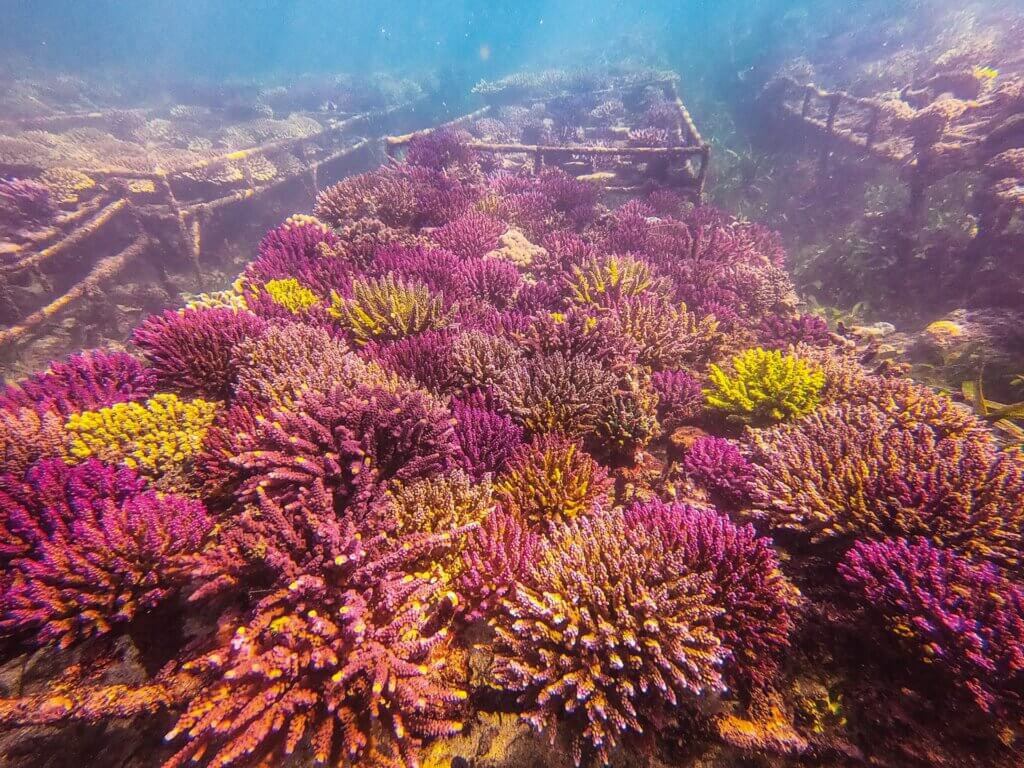
Mariculture, a form of aquaculture, in Indonesia (Indonesia Expat)
Is coral harvesting sustainable?
The Coral Fishery operates within an ecosystem under immense pressure from climate change. Due to risks posed by the Coral Fishery and evidence of localised depletion of some of the primary target species, AMCS holds serious sustainability concerns for some corals, including rare species found nowhere else but the Great Barrier Reef.
The latest Great Barrier Reef Outlook Report 2024 states that the Reef’s outlook remains very poor, and the Reef has suffered six mass bleaching events in the last decade. The 2024 mass bleaching event affected all regions of the Great Barrier Reef and has been described as the most severe and widespread bleaching event on record. The same coral species affected by bleaching events are targeted by the Coral Fishery.
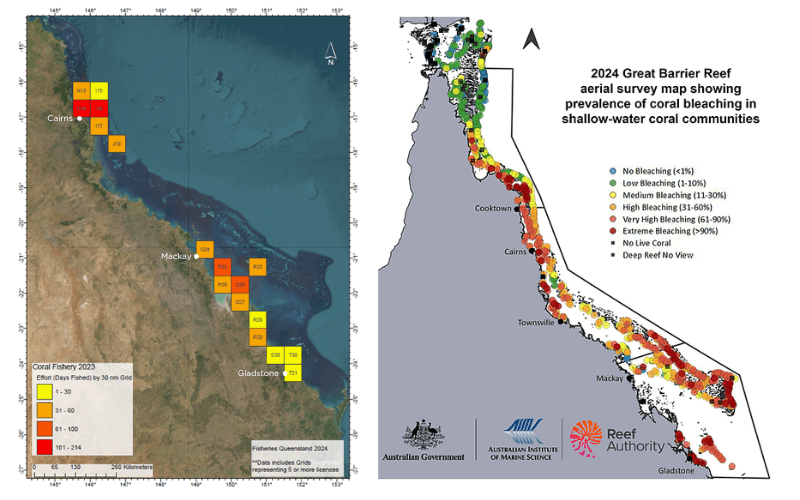 Figure 1: A comparison of coral fishery fishing effort (grid cells with more than 5 licences only) and observed bleaching via aerial surveys during the 2024 mass bleaching event. Note that an absence of effort days on the fishing heat map does not mean that no fishing activity took place at that location, only that it may have been conducted by less than 5 licences.
Queensland fisheries data shows that the majority of coral harvest occurs off the Mackay and Cairns regions, followed by south Queensland and the Keppel Islands. All of these areas have been severely affected by recent mass bleaching events. Bleaching was particularly severe in the southern Reef and Keppel region in 2024, while the aerial surveys show a high proportion of reefs off Mackay and Cairns suffering from high to extreme bleaching.
It is highly likely that a large proportion of the reefs where the Coral Fishery operates were subject to high heat stress and high to extreme levels of bleaching (see Figure 1), with some of the largest reductions in coral cover observed on the northern and southern Reef.
Risks to corals targeted by the fishery
Studies of some of the most sought after corals within the fishery, including specialty corals Homophyllia cf australis and Micromussa lordhowensis, show them to be extremely vulnerable to heat stress. In fact, every coral species targeted by the fishery has died when exposed to high temperatures.³ Acropora and Pocillopora are another two target corals particularly vulnerable to warming oceans, coral bleaching and mortality.
Some of the corals targetted by the Queensland Coral Fishery are endemic and found nowhere else in the world. Homophyllia cf. australis is also naturally rare, and only found in small pockets of the Great Barrier Reef. The fishery’s most recent Ecological Risk Assessment identifies Homophyllia cf. australis and Micromussa lordhowensis to be at extreme risk from fishing, Euphyllia glabrescens to be at high risk, and three other species to be at medium risk.⁴ However, these risk levels were established before species level catch limits were implemented, and a new risk assessment is expected later in 2026.
Latest science on the impacts of coral harvesting
Sustained fishing pressure from the Queensland Coral Fishery has led to localised coral depletion according to recent studies. Research was undertaken to compare the biomass of nine of the high-value specialty corals in areas where harvesting is permitted versus ‘no take’ areas on the Great Barrier Reef. Densities of five out of the nine specialty coral species were significantly lower in fished areas compared to ‘no-take’ areas.⁵
Due to the difficulties in identifying some Acropora species, fishers report Acropora to the genus not the species level. Recent research undertaken to determine the catch composition of Acropora species in the fishery showed that catch was dominated by a small number of different species, with 10 species representing more than 54% of catch, and Acropora aff. microclados making up 22% of samples.
Taking healthy corals out of the ecosystem when they have survived major shocks such as bleaching, cyclones and flooding, reduces the Reef’s ability to adapt to changing environmental conditions, ultimately reducing its health and ability to recover.
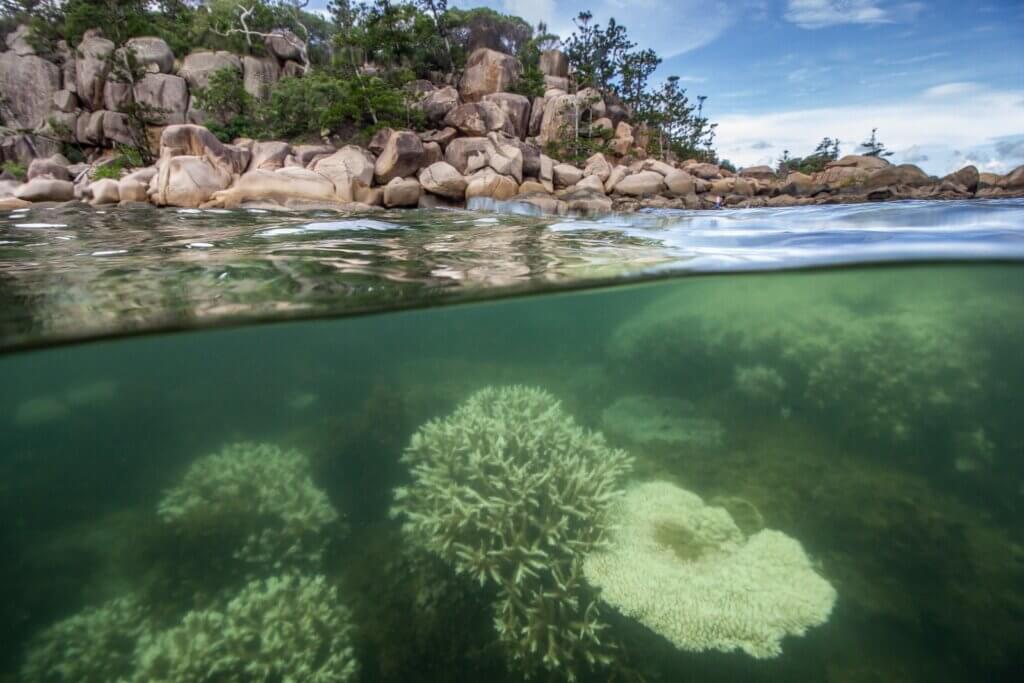
Sediment pollution and bleached corals at Magnetic Island (Max Hirschfeld)
How does coral harvesting compare to other threats to coral?
- While the Coral Fishery is not the main cause of coral mortality on the Great Barrier Reef, harvesting occurs in an ecosystem facing the cumulative pressures of climate change, water pollution and unsustainable fishing.
- AMCS is actively working to address these major threats to our precious corals and the Great Barrier Reef.
Climate change
Climate change is without question the biggest threat to the Great Barrier Reef and coral reefs worldwide. Climate change is causing marine heatwaves that supercharge mass bleaching events, cyclones and floods, all of which are major sources of coral mortality. The Great Barrier Reef has now experienced six mass bleaching events in the last decade, including in 2022, during a typically cooler La Nina period. Scientists tell us that once we hit 1.5C of global warming coral reefs will struggle to survive. If we don’t keep 1.5C of warming within reach this decade, the harsh reality is we will see more mass bleaching events and the rapid decline of our global icon.
Water pollution and unsustainable fishing
Local threats like water pollution and unsustainable fishing practices are also known to make the Reef less resilient, and in some cases directly cause coral mortality. Water pollution caused by poor agricultural practices such as deforestation, particularly along waterways, and excessive fertiliser use creates sediment and nutrient run-off. These pollutants can both smother corals and supercharge algal growth, both of which can lead to coral mortality and disease. Unsustainable fishing practices including illegal fishing, overfishing and damage from anchors can all impact corals.
Natural causes of coral mortality
In addition to human-caused drivers of coral mortality, there are natural factors at play. Crown of thorns starfish (CoTS), while a natural part of reef ecosystems, are voracious coral predators that can breed rapidly and reach very high numbers. These CoTS outbreaks can lead to widespread coral mortality.
Some fish species are natural predators of corals, including the bumphead parrotfish. While they may consume more corals than are harvested by the fishery, they are of course a natural part of the ecosystem and not selectively harvesting corals for profit. Acropora corals tend to make up the bulk of a bumphead parrotfish’s diet, rather than the naturally rare and in some cases endemic species targeted by the fishery.
By minimising all sources of coral mortality – including impacts of the Queensland Coral Fishery – the Reef is better equipped to face the cumulative pressures of climate change, water pollution and unsustainable fishing.
How do we protect the Great Barrier Reef from coral harvesting?
- Fortunately a solution already exists: tank-grown corals, known as aquaculture.
- Aquaculture has the capacity to replace the demand for the wild harvest of corals from the Great Barrier Reef.
- Aquaculture provides opportunities to breed corals with desirable characteristics, optimise growth and minimise the risk of disease, stress, bleaching and predation.
Many Coral Fishery operators already have facilities on land where corals are stored prior to sale. In some cases these facilities are used for growing out corals.
In tank settings, harvested corals are either bred or ‘fragged’ – where the colony is carefully cut into multiple pieces – and grown out for sale. Fragging can occur indefinitely and retains the genetic characteristics of the mother colony, while breeding coral requires a full understanding of the corals’ lifecycle but produces many more corals that can be grown out for sale.
A permit is required under Australian environmental law to export corals bred in captivity. Two operators hold these permits, allowing them to export multiple generations of the most in-demand and heavily harvested corals.
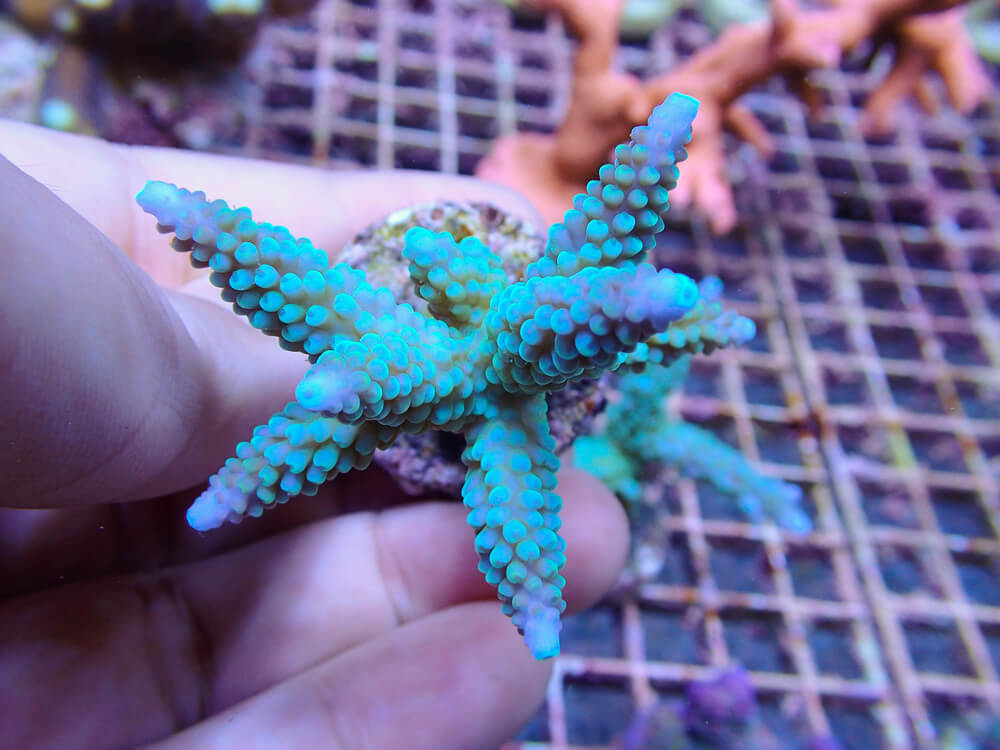
Coral frag
Isn’t aquaculture energy-intensive?
High energy costs and emissions are a current limitation of coral aquaculture.
As mentioned, most operators already have land-based facilities where they store corals. Scaling facilities up to grow out captive-spawned or fragged corals would increase their energy demands. Growth rates vary by species, so corals may need to spend months or even years in a facility before they’re ready for sale. Maintaining optimal growing conditions – light, temperature, water, chemistry – requires energy-intensive tank infrastructure, which produces emissions. That said, the wild harvest industry also causes emissions from fuelling boats out on the Reef.
This is a valid challenge for businesses, but it’s solvable. The industry could be powered by clean energy with the right support, such as on-site renewable energy and power purchase agreements with renewable energy providers.
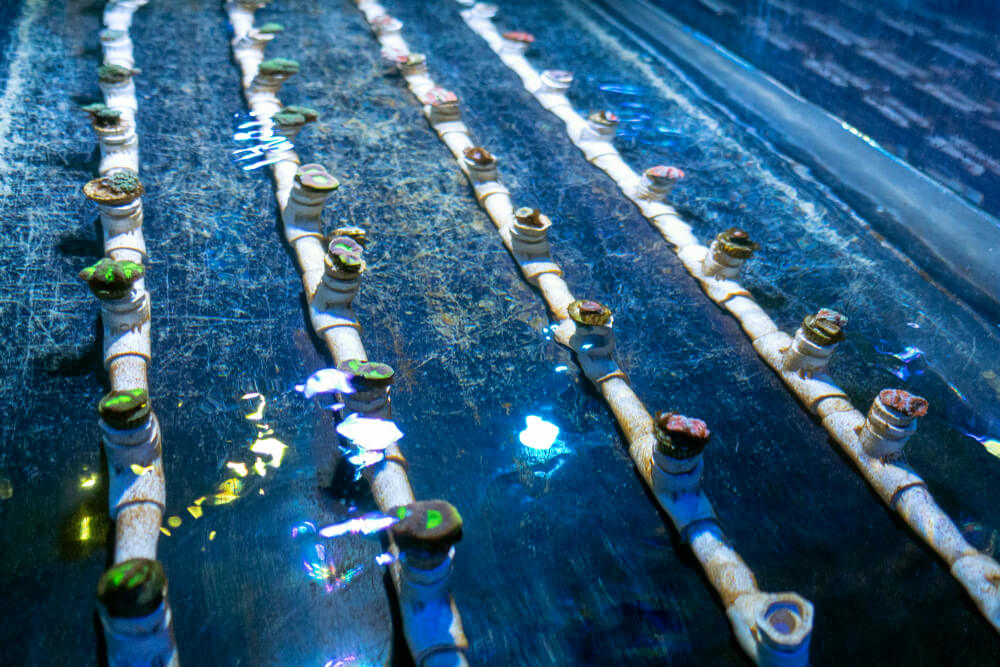
Hard corals growing in tanks
What can the future look like for the coral fishing industry?
- Businesses are already demonstrating that an aquaculture model is a viable alternative to harvesting wild corals.
- The broader industry will require support to complete such a transition.
- Fishing businesses still have a future and the potential to increase employment to support coral aquaculture and restoration.
Coral harvesting businesses engaged in aquaculture have advanced the sector considerably. Yet this progress sits alongside a contradiction: the Australian Government has spent over $200 million on the Reef Restoration and Adaptation Program (RRAP), much of it funding the growth of heat-tolerant corals that are then returned to the Reef. It’s hard to reconcile spending hundreds of millions of dollars restoring reefs while continuing to legally permit the harvest of hundreds of thousands of corals from those same reefs each year.
Scaling up restoration, and transitioning the Coral Fishery, will depend on partnerships between the public and private sectors that draw on the expertise of coral fishers and aquarists who already know how to do this work.
Government support could include compensation for loss of fishing access to the Great Barrier Reef, grants or interest-free loans for renewable energy or aquaculture expansion, education and training to ensure ongoing staff availability, and research and development to optimise breeding and growth of commercially valuable corals.
With the right support, the same fishing businesses can continue to exist and grow, employing more people in aquaculture and restoration, while those already working in ocean-based roles like skippers and divers remain essential to coral deployment on the Reef. The key difference will be that the corals headed for the global aquarium trade will be grown in tanks rather than taken from the Great Barrier Reef.
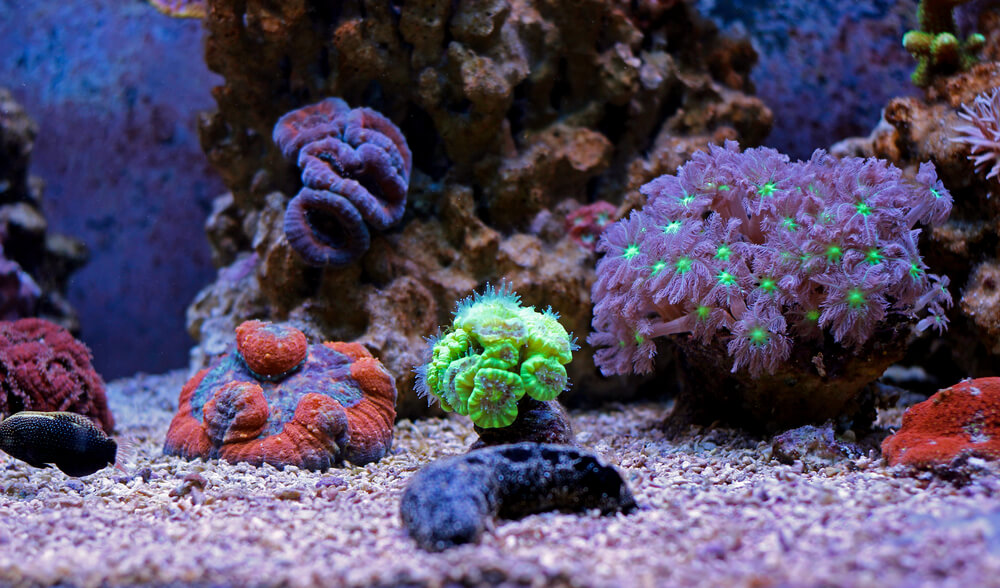
Will people still be able to have aquariums in the future?
Both public and private aquariums can play an important role in education and fostering a love of coral reefs. With the right government support there should be no noticeable change to coral availability.
Corals must be traceable so it is clear whether they are aquacultured or wild harvested. Corals are one of the world’s most traded animals, and both wild harvest and aquaculture already occurs in Australia. The Australian Government has recently developed a traceability system for corals that can identify corals as wild harvest or aquacultured and track them through the supply chain. This will be vital into the future to ensure sustainability.
For aquarium hobbyists that are interested in sustainability, it’s important to know where your coral has come from. Simple questions such as asking whether a piece has been harvested from the wild or produced in aquaculture can help you to make environmentally-friendly choices.
What can I do to help stop coral harvesting on the Great Barrier Reef?
You can urge the Australian Government to support the coral industry to transition from wild harvest to tank-grown aquaculture. Join the thousands of Australians calling for this change. Email Environment Minister Murray Watt to show your support for ending coral harvesting on the Great Barrier Reef.
Wild corals belong on the Reef, not in the world’s aquariums.

- Frew M. (2026), Great Barrier Reef harvester Dean Pease defends coral trade against AMCS’s export ban campaign, The Cairns Post, available at cairnspost.com.au
- BDO Econsearch (2021), Economic and social indicators for the Queensland coral harvest and marine aquarium fishery, 2017/18 and 2018/19
- Pratchett, M.S., Caballes, C.F., Newman, S.J. et al. Bleaching susceptibility of aquarium corals collected across northern Australia. Coral Reefs 39, 663–673 (2020). https://doi.org/10.1007/s00338-020-01939-1
- Morton, J., Jacobsen, I. and Dedini, E. (2022) Queensland Coral Fishery Ecological Risk Assessment Update : Phase 1. Technical Report. State of Queensland
- Pratchett MS (2024) Localised status assessment for specialty coral harvest species on the Great Barrier Reef, Department of Climate Change, Energy, the Environment and Water (DCCEEW). https://www.dcceew.gov.au/sites/default/files/documents/qld-coral-localised-status-assessment-2024.pdf